





Before Rosehaven | Book 0

Before Ella found love at The Harbour Cottage, she had to find the strength to leave.
Three years before Rosehaven Bay, Ella Hart thought she had the life she wanted.
Before Rosehaven is the story of what happens when everything changes, and Ella must find the courage to reclaim her voice and begin again
Before Rosehaven Playlist
Music has always brought emotions closer. These are some of the songs I listened to while writing Before Rosehaven.
They became part of Ella's journey… 🎧♡
Discover Before Rosehaven
Three years before Rosehaven Bay, Ella Hart had the career, relationship, and future she thought she wanted.
A talented architect with a thriving design studio, Ella knows how to preserve the character of old buildings while making room for something new. But recognising what needs to change in her own life proves far more difficult.
As success arrives, Ella’s ideas earn praise while her own voice grows quieter. What begins with seemingly small compromises gradually leaves her questioning her judgement, her work and the future she thought she was building.
When Ella can no longer ignore what she has been losing, she faces a choice: remain in the life she knows or find the courage to step away and begin again.
With her architectural work to protect and loyal friends beside her, Ella begins the difficult journey of reclaiming her voice, trusting her instincts and deciding what she wants her future to look like.
Before Rosehaven is a heartfelt prequel about friendship, creative ownership, resilience and the quiet courage it takes to choose yourself. It isn't Ella's happily-ever-after, not yet. It is the story of how she finds the strength to take the first step towards it.
Before Ella found love at The Harbour Cottage, she first had to find her way back to herself. The manuscript confirms that Ella's romantic story continues in The Harbour Cottage.
Sometimes, before you can find where you belong, you have to find your way back to yourself.
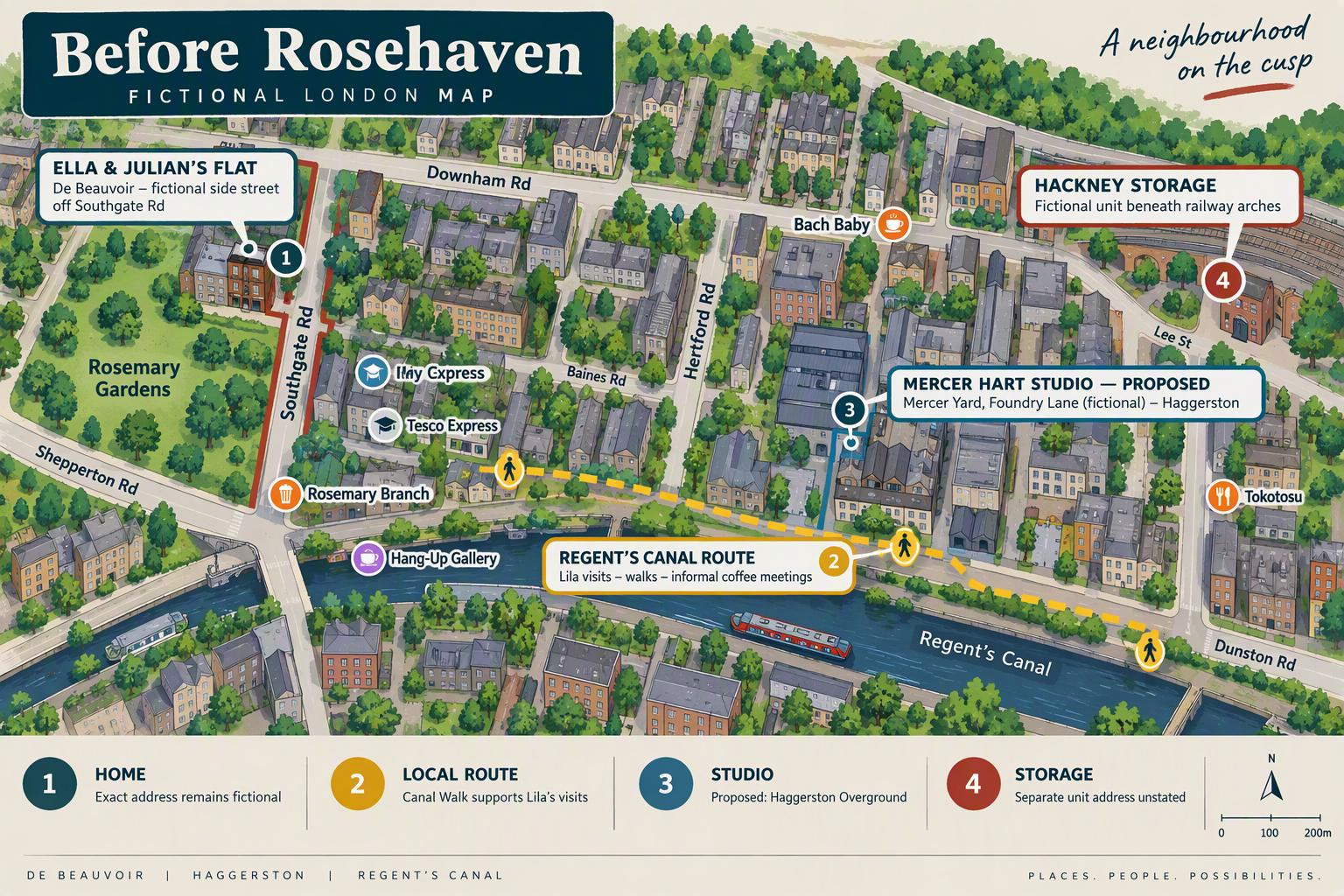
MAP NOTE & DISCLAIMER
Before Rosehaven is a work of fiction. This illustrated map is inspired by London's geography and atmosphere, but has been adapted for storytelling purposes. Locations, addresses, businesses, studios and other details associated with the characters are fictional. Any resemblance to actual people, residences, businesses or establishments is entirely coincidental and is not intended to depict or refer to any real person, property or organisation. The map is illustrative only and should not be considered geographically or navigationally accurate.

She left the studio before the certainty in her chest could give way to the familiar urge to soften her tone. For the next few hours, she walked through the rain and sat in a quiet café near King’s Cross, going over the audit sheets in her portfolio.
Author’s Note
I chose this moment because it marks a quiet change in Ella.
She hasn’t made any dramatic decisions yet. She simply removes herself from the noise, finds somewhere to sit, and looks again at what she already knows.
For me, that matters. Sometimes finding your voice doesn’t begin with saying something out loud. It begins with giving yourself enough space to hear your own thoughts clearly and trusting what they’re telling you.
Before Rosehaven is, in many ways, the story of Ella learning to do exactly that.

When Ella moved one slightly to the left to reach the sample board, he carried it back before the dust settled. He said the view from the doorway looked cleaner that way.
The exchange lasted less than twenty seconds. The room accepted his arrangement. So did she.
The scuff remained on the floorboards when she returned to her drawings.
Author’s Note
I chose this moment because it’s so easy to overlook. Nothing dramatic happens. It lasts only a few seconds, and Ella simply returns to what she was doing. But that’s what makes the moment important to me.
Sometimes we don’t realise how often we’ve started making space for someone else’s preferences, or how easily we’ve learnt to let the small things go. Individually, they may seem insignificant. Over time, though, they can quietly change how much space we allow ourselves to take up.
I love the small detail of the scuff left behind on the floorboards. Ella carries on, but a trace of what happened remains.
For me, this is where her journey begins: noticing the things she once accepted without question and slowly learning to trust her own voice again.

Ella understood the buildings themselves: the belly of a lath-and-plaster ceiling, which settled in a stair was structural and which was merely the timber finding its bed, and where daylight could be brought down a narrow lightwell to alter the temperature of a passage.
She showed them how an uneven flagstone or a patched architrave held the history of a room’s use.
Author’s Note
I love this moment because it shows a side of Ella that has always felt important to me.
She doesn’t simply look at an old building and see its imperfections. She understands why they are there. She notices what has shifted, what has survived and what tells the story of the people who once lived within those walls.
There is something beautiful about being able to see value in what others might be tempted to straighten, replace or hide.
For me, this passage is also quietly about Ella herself. She understands that age, change and imperfection do not make something less worthy. They can be part of its history and part of what gives it character.
Perhaps learning to offer herself that same understanding is another part of her journey.
© 2026 Zera Deen. All rights reserved.